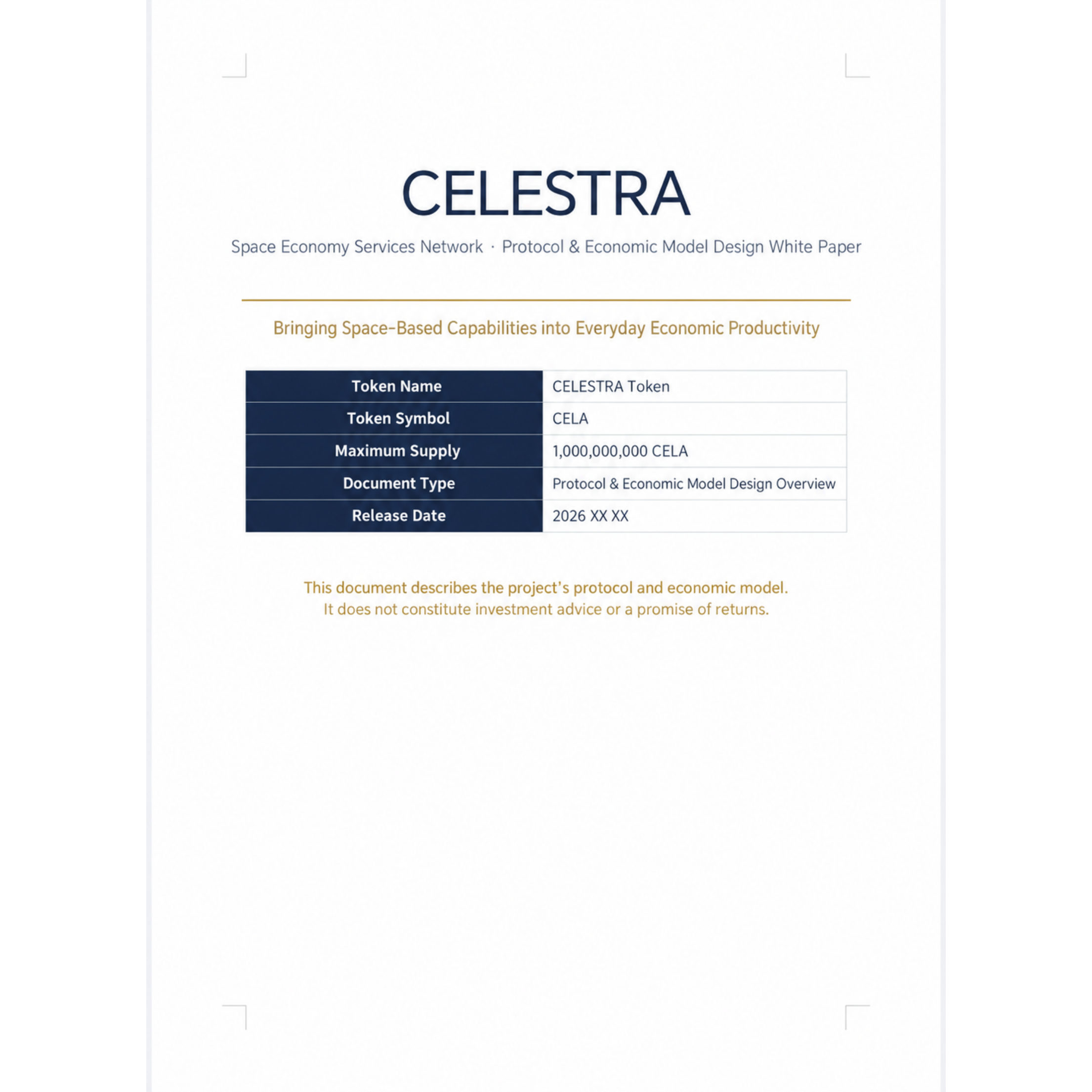
Space Economy Services Network

CELESTRA

Bringing space-based capabilities into everyday economic productivity.

A collaborative delivery network that connects satellite data, professional computing and industry service organizations through one unified order system — with standardized services, verifiable delivery and transparent settlement.

Native token
CELA
Maximum supply
1,000,000,000
Network model
Order-driven
Document
Protocol & economic design
01Overview

Space capability,
delivered as a commercial service.

The space economy turns orbital infrastructure into productive tools on Earth. CELESTRA organizes the fragmented delivery chain between the two.

Satellites provide observation, communications connect remote regions, and positioning and timing systems support billions of devices. What businesses actually pay for are the results: more timely information, broader coverage, more efficient analysis, and standardized services that can be embedded in business workflows.

A complex chain still separates space resources from business outcomes — resource discovery, data authorization, task decomposition, algorithmic processing, quality verification and settlement among multiple parties. CELESTRA is built as a distributed collaboration network for that chain, connecting data providers, computing service providers, algorithm developers and industry service organizations.

Standardized services, clear acceptance criteria, verifiable delivery records and transparent fulfillment rules — organized into commercial products that can be purchased, delivered and used sustainably. CELESTRA White Paper, Chapter 1
1B

Fixed maximum supply of CELA

4

Core network products

5

Core network responsibilities

5

Deliverable-gated phases

Token system

CELA covers participation guarantees, verification responsibilities, contribution allocation and protocol governance.

Economic structure

Two layers: business services settle in stable-value currency while CELA carries network-level responsibilities.

Initial market

Regional-change monitoring for infrastructure, energy facilities and land-asset management.

Network mission

A space-economy services network coordinated by real orders, professional delivery support and public protocol rules.

02The Value Chain

From orbit to
everyday operations.

Commercial value follows a clear path. Infrastructure sets the supply limit; service organizations determine how efficiently those capabilities are used.

01

Space Infrastructure

Sensing, connectivity and positioning — the foundation of every downstream service.

02

Data & Connectivity

Authorized, usable resources made accessible across regions and organizations.

03

Computing & Processing

Modeling, algorithmic analysis and professional processing turn raw data into answers.

04

Standardized Services

Packaged, priced and catalogued products with defined delivery and acceptance rules.

05

End Users

Completed outcomes: better information, faster decisions and new business capability.

+

Broader Information Coverage

Space assets cover large areas at relatively low marginal cost.

+

Continuous Monitoring

Repeated imagery supports time-series and subscription service models.

+

Shorter Decision Cycles

Analysis results arrive without requiring access to raw satellite data.

+

Cross-Regional Collaboration

Shared standards for coordinates, time and output formats.

+

Reusable Software Capability

Proven workflows and algorithm modules serve multiple clients and reduce delivery cost.

Customer net value = reduced labor costs + value of better and more timely information + value of new business capabilities − procurement and integration costs
03The Network

One network.
Five core responsibilities.

CELESTRA is a collaborative delivery network for space data and professional computing services. It does not build satellites; it makes existing space capability commercially usable.

01

Unify Service Descriptions

Standardize service definitions and catalog management to eliminate information gaps in procurement.

02

Coordinate Tasks

Organize and schedule complex tasks across multiple parties, with a defined owner for every step.

03

Manage Delivery Evidence

Store and track delivery evidence for verification and traceability from start to finish.

04

Coordinate Acceptance & Settlement

Coordinate acceptance workflows and handle settlement among multiple parties.

05

Maintain Shared Protocols

Establish and maintain the network's shared protocol rules, parameters and upgrade paths.

Starting where recurring demand already exists: regional-change monitoring.

The initial business offering tracks change across infrastructure, energy facilities and land assets — recurring needs that require repeated observation over time, can be ordered by region and frequency, and scale from simple image processing to cross-industry analysis.

Essential need Customizable orders Scalable scope
04Core Products

Four products.
One delivery standard.

A marketplace for buying, an engine for coordinating, a module for verifying and an API for integrating. Together they turn a fragmented delivery chain into a commercial service.

01 / MARKET

CELESTRA Market

Standardized Services Marketplace

A unified product catalog where every listing carries the information a buyer needs before an order is placed. Services that omit required fields cannot be published as standard products.

Required for every listing

Service scopeData specificationsInput requirements Delivery contentsService timelineAcceptance method PricingLiability terms
02 / FLOW

CELESTRA Flow

Intelligent Task Orchestration Engine

Complex orders are decomposed into independent tasks and executed through a standardized workflow. Each sub-task specifies its provider, deliverables, timeline and settlement allocation.

Standard workflow

Acquisition→Preprocessing→Analysis→Expert review→Delivery

If a preceding task misses its acceptance criteria, subsequent tasks pause automatically and the exception is recorded in detail.

03 / VERIFY

CELESTRA Verify

Multi-Level Delivery Verification

Three independent verification layers prevent a file upload from being mistaken for service completion. Each layer is recorded separately; if any layer fails, the delivery is non-compliant.

Three verification layers

01Completeness. All files present; hashes match summary records.
02Specification. Area, time range, format and fields match the order.
03Professional quality. Results meet agreed professional and business standards.
04 / API

CELESTRA API

Industry-Standard Integration Gateway

Enterprise systems create orders, follow execution and retrieve results programmatically. Strict version control keeps client integrations stable; breaking changes ship with migration and transition periods.

Capabilities

Task managementQuote retrievalStatus checks Result downloadsEvent notificationsQuota checks
05Order Lifecycle

Every order,
fully accounted for.

A single status machine, with exceptions recorded separately rather than hidden. Acceptance, payment and remediation follow rules that are agreed before work begins.

Created → Confirmed → In Planning → In Progress → Delivered → Under Review → Closed

Exception states · recorded in parallel

Pending information Delayed execution Rework required Business dispute Order cancellation Refund processing
01

Before activation

No order goes live until six items are confirmed:

  • Service scope and data authorization boundaries
  • Deliverables and acceptance criteria
  • Pricing and payment terms
  • Delivery timeline and key milestones
  • Provider participation and commitment requirements
  • Dispute resolution process
02

Acceptance

Standard products are accepted automatically seven calendar days after delivery when all five default conditions are met: notification sent, results accessible, automated checks passed, no client objection, and product terms allow auto-acceptance.

  • Custom projects follow terms stated in the order
  • A raised dispute pauses the corresponding payment
03

Remediation & refunds

If results do not meet order requirements, the provider must prioritize remediation. Unresolved, significantly delayed or cancelled delivery triggers a partial or full refund, with contractual penalties assessed accordingly.

06The CELA Token

Participation,
not payment.

CELA is the native protocol token. Business runs on stable-value settlement; CELA carries network-level responsibilities — guarantees, verification, contribution and governance.

Token name
CELESTRA Native protocol token
Symbol
CELA Protocol participation layer
Maximum supply
1,000,000,000 Fixed; no additional issuance
Initial circulation at TGE
50,000,000 5% of maximum supply
Layer 01

Business Settlement Layer

Value asset · Stable-value currency

Real commercial transactions with end customers. Clients purchase services and service providers earn rewards — without needing to hold CELA.

Operation modelCommercial transactions
Price exposure for clientsNone from CELA volatility
Layer 02

Protocol Participation Layer

Value asset · CELA token

Network participants stake and commit. Service providers, validators and governance participants stake CELA and are responsible for network security and conduct.

Operation modelStake and commit
Who participatesProviders · validators · governance
01

Service Participation & Assurance

Encourages service providers to operate in compliance with network rules.

02

Validation & Accountability

Requires validators to participate in network validation and business reviews.

03

Ecosystem Contribution Rewards

Allocates a limited ecosystem budget to meaningful, verified contributions.

04

Protocol Governance

Enables voting on network rules, budgets and parameter changes.

Demand follows real participation: more qualified participants lead to a greater assurance scale, expanded validation and governance activity, and continued network usage. CELA does not promise fixed returns or price appreciation; business growth and secondary-market price have no fixed conversion ratio.
07Service Providers

Stake to participate.
Perform to stay.

Staking is a commitment mechanism, not a substitute for professional qualification review. Tiers determine the scope a provider can serve after onboarding.

Registered Provider
20,000 CELA minimum stake

Basic standardized services after review.

Independent Validator
50,000 CELA minimum stake

Validation and review work after professional vetting.

Professional Provider
100,000 CELA minimum stake

Multiple product lines and long-term service projects.

Core Provider
300,000 CELA minimum stake

Multi-stage complex collaboration and high-value service reliance.

Onboarding checklist

  1. Identity verification of the entity and responsible person
  2. Review of resource and data access qualifications
  3. Evaluation of sample delivery and testing
  4. Confirmation of service specifications and documentation
  5. Compliance and data processing review

Exit rules

A participant may apply to exit and have their stake refunded, subject to a standard 30-day cooling-off period. If a business dispute exists, only the portion of stake matching the disputed amount is frozen; the remainder is unaffected.

Violations

GeneralWarning, time-limited correction, new tasks suspended.
SeriousPart of staked CELA deducted; network access restricted.
Systemic fraudPermanent ban; staked assets confiscated according to the rules.

Penalties apply only to objectively verified malicious violations, are published in advance and are never added retroactively.

08Tokenomics

Fixed at one billion.
No minting.

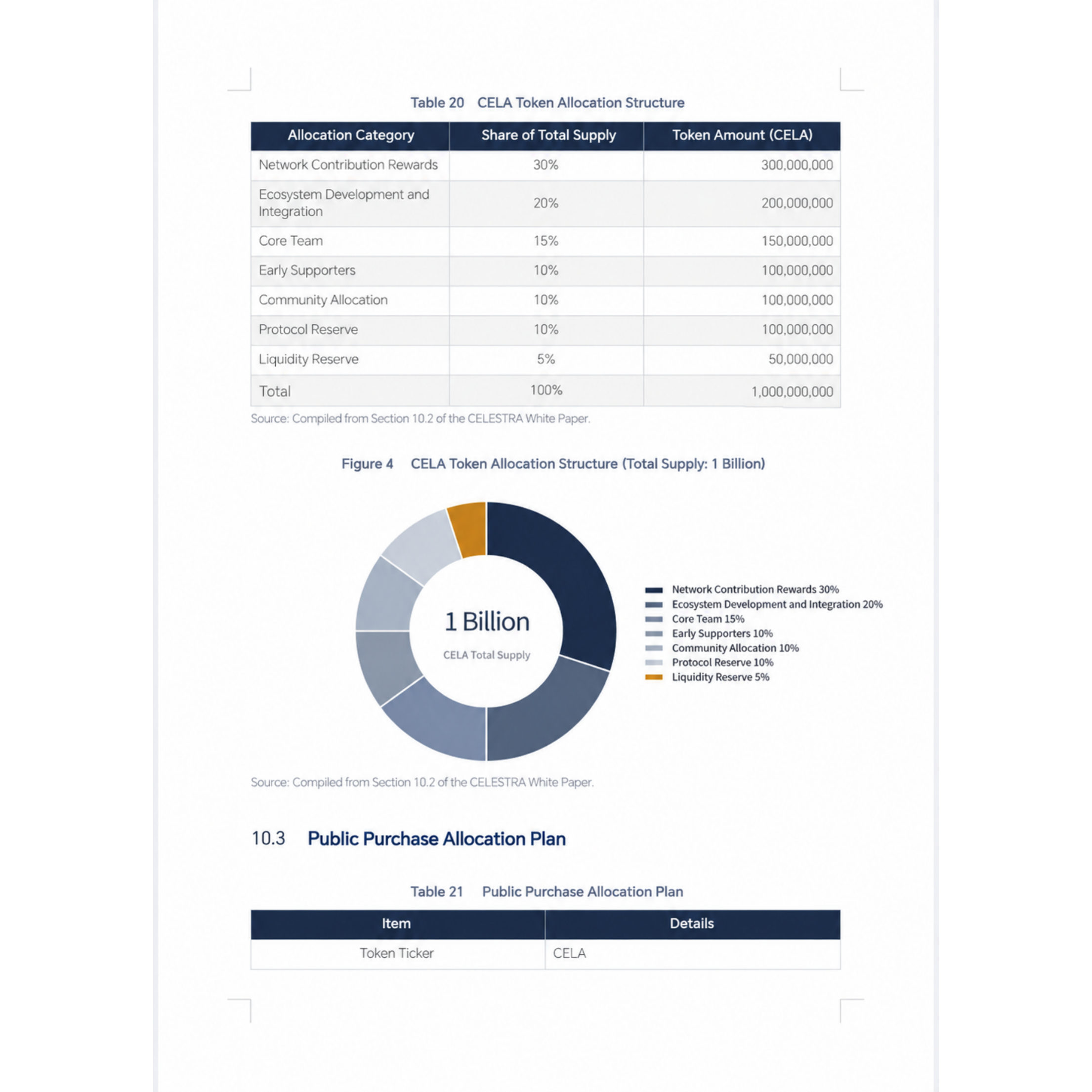
Total supply is capped at 1,000,000,000 CELA at the contract level. Budgeted tokens are held in public accounts and released automatically on schedule, without manual intervention.

1 Billion CELA total supply
Network Contribution Rewards 30% 300,000,000
Ecosystem Development & Integration 20% 200,000,000
Core Team 15% 150,000,000
Early Supporters 10% 100,000,000
Community Allocation 10% 100,000,000
Protocol Reserve 10% 100,000,000
Liquidity Reserve 5% 50,000,000

No new CELA can be minted through the token contract. The total supply is permanently capped.

Initial circulating supply at TGE

50,000,000 CELA · 5% of maximum supply

Community allocation
20,000,000 Released at TGE
Liquidity reserve
20,000,000 Released at TGE
Ecosystem development
10,000,000 Released at TGE
Team · early supporters · protocol reserve
0 Locked at TGE

Vesting rules

Lock-ups align long-term participants with network delivery.

Core Team 12-month lock-up
then 36-month linear release
Early Supporters 12-month lock-up
then 24-month linear release
Community Allocation No lock-up
24-month linear release after TGE
Protocol Reserve At least 24-month lock-up
then release subject to governance approval

Network contribution rewards

Maximum annual release caps across the first eight network years.

Values in millions of CELA; total 300,000,000 over eight years. Caps are maximum limits, not release requirements — unused amounts carry over, and next-year usage cannot exceed that year's cap.

09Implementation Roadmap

Deliverables
are the gate.

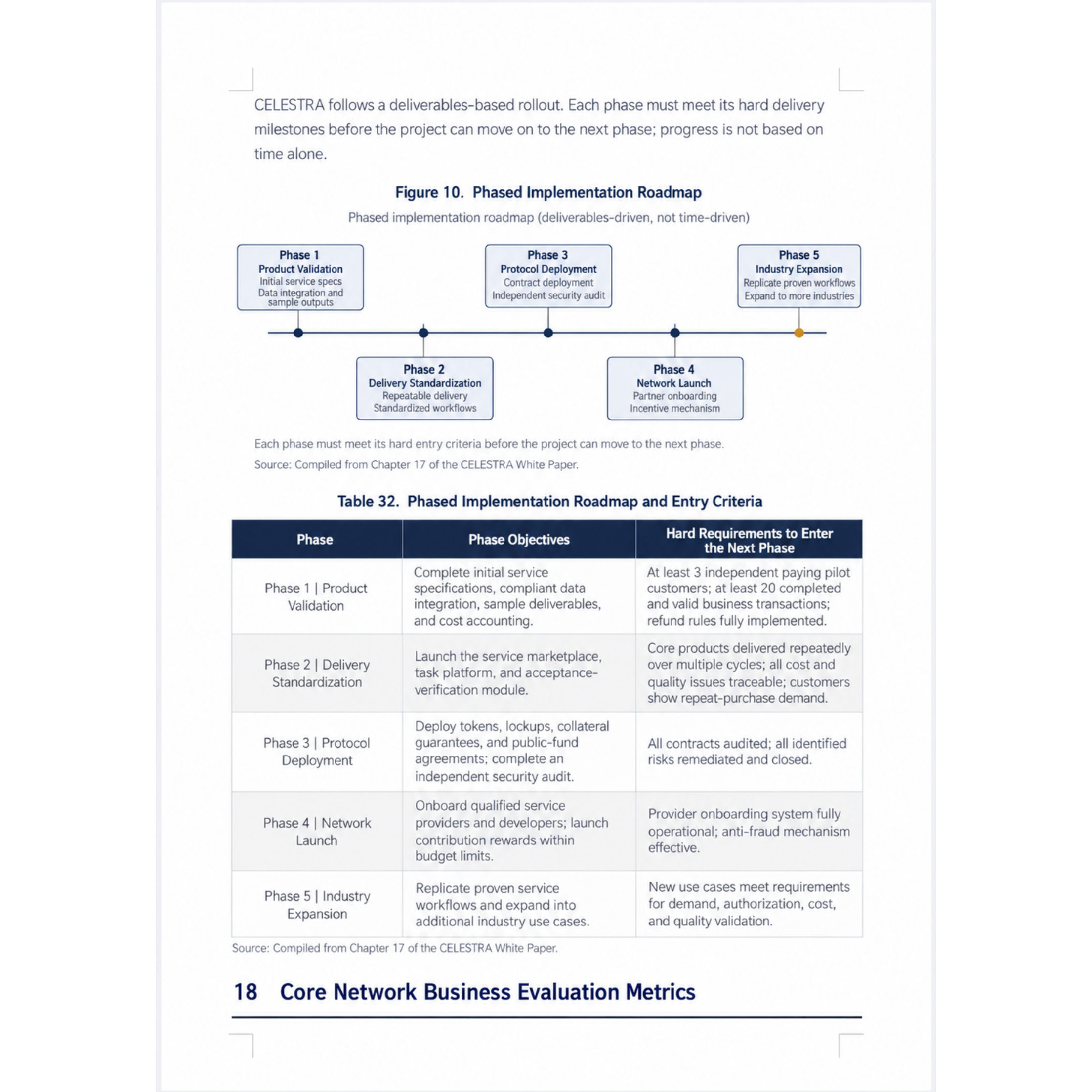
CELESTRA follows a deliverables-based rollout. Each phase must meet hard delivery milestones before the project moves on; progress is not based on time alone.

Phase 1

Product Validation

Initial service specifications, compliant data integration, sample deliverables and cost accounting.

Gate to enter Phase 2At least 3 independent paying pilot customers; at least 20 completed valid business transactions; refund rules fully implemented.
Phase 2

Delivery Standardization

Launch the service marketplace, task platform and acceptance-verification module.

Gate to enter Phase 3Core products delivered repeatedly over multiple cycles; cost and quality issues traceable; customers show repeat-purchase demand.
Phase 3

Protocol Deployment

Deploy tokens, lock-ups, collateral guarantees and public-fund agreements; complete an independent security audit.

Gate to enter Phase 4All contracts audited; all identified risks remediated and closed.
Phase 4

Network Launch

Onboard qualified service providers and developers; launch contribution rewards within budget limits.

Gate to enter Phase 5Provider onboarding system fully operational; anti-fraud mechanism effective.
Phase 5

Industry Expansion

Replicate proven service workflows and expand into additional industry use cases.

GateNew use cases meet requirements for demand, authorization, cost and quality validation.

Source: CELESTRA White Paper, Chapter 17.

10Governance & Security

Rules written down,
before they matter.

Governance covers public budgets, reward parameters, service-quality collateral, protocol fees and technology upgrades. Commercial client contracts and internal employment remain outside its scope.

≥ 7 daysPublic discussion period
7 daysFormal voting period
72 hTimelock for routine upgrades
1MCELA minimum to submit a proposal
10%Voting quorum of eligible votes
> 50%Passing threshold, regular proposals
≥ 2/3Passing threshold, core rule changes

Fund safeguards

  • 3-of-5 multi-signature required for any public-fund transaction
  • Client custody, operating, rewards, ecosystem, contingency and liquidity funds held in segregated accounts
  • Minimum 12 months of operating cash maintained
  • Unrealized gains from CELA tokens are not counted as cash

Security framework

  • Access control review, core functionality testing and independent third-party audit before launch
  • Vulnerability remediation and emergency drills completed before asset-related modules go live
  • High-risk discoveries trigger suspension of affected functionality — up to 72 hours before a public explanation is required
  • Emergency authority is limited to pause; no power to transfer user assets

Disclosure cadence

  • Monthly: token releases, reward distributions, major ecosystem investments, key incidents
  • Quarterly: business quality metrics, public-fund expenditures, asset holdings, related parties, next-period budget
  • Immediate: security incidents, permission changes, critical service outages, material changes affecting user rights

User metrics

Paying customers, repeat purchase rate, subscription status, engagement and concentration risk.

Transaction metrics

Payment success rate, verification pass rate, refund rate and dispute rate.

Financial metrics

Net revenue, gross profit from orders, cash burn rate and incentive cost share.

Protocol ecosystem

Active service providers, total collateral, governance participation and security incident statistics.

Token price and secondary-market trading activity are not used as measures of network development. External metrics are updated and explained quarterly.

The White Paper

This is the overview.
The protocol is in the paper.

Thirty-four pages covering the products, order lifecycle, on-chain architecture, token design, staking, allocation, vesting, governance, risk controls and disclosure policy — in full.

34 pages PDF · 37 MB Read online or download